What is NVIDIA GTC Berlin?
NVIDIA GTC Berlin 2026 runs from October 20 to 22, and it brings NVIDIA's flagship AI conference format to the German capital. Three days. One keynote. More than 100 sessions.
GTC stands for GPU Technology Conference, and while the flagship edition takes place every spring in San Jose, NVIDIA has been taking the format on the road, with Berlin now hosting the European edition that combines the NVIDIA keynote in Berlin, a full conference program, an expo floor and hands-on training in one place. The headline moment is CEO Jensen Huang on stage at the Tempodrom on October 21. Everything else happens at STATION Berlin, a converted industrial venue in Kreuzberg just a few minutes' walk away.
The program covers the whole AI stack, from CUDA and accelerated computing to agentic AI, open models, robotics and physical AI. NVIDIA pitches it at developers, researchers, startup founders and enterprise architects, which in practice means you will find everyone from PhD students to board members in the same coffee line.
This guide pulls together everything you need to know: dates, venues, how to get there, who is speaking, what the NVIDIA keynote in Berlin will likely cover, what tickets cost and a set of FAQs at the end. All details come from the official GTC Berlin site and are current as of late September 2026.
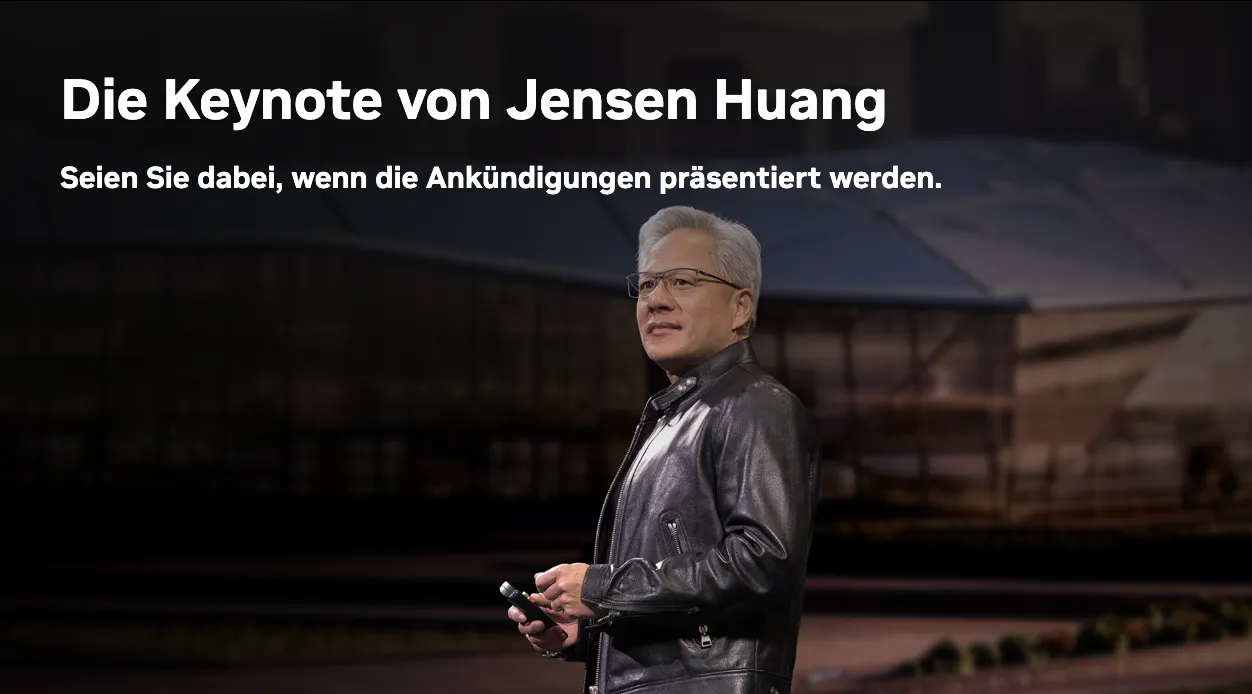
Image Credits: Nvidia, https://www.nvidia.com/en-eu/gtc/
When and where: dates and venues for Nvidia GTC
GTC Berlin 2026 takes place from Tuesday, October 20 to Thursday, October 22, 2026, across two venues in Berlin-Kreuzberg.
Day | What happens | Where |
|---|
Tue, Oct 20 | Full-day hands-on workshops (separate workshop registration, and lunch) | STATION Berlin |
Wed, Oct 21 | GTC Live pregame show, Jensen Huang keynote (11:00 to 13:00 CEST), then sessions, expo, training and the evening expo reception | Tempodrom, then STATION Berlin |
Thu, Oct 22 | Sessions, expo hall, training workshops and certifications | STATION Berlin |
The keynote venue is the Tempodrom, Möckernstraße 10, 10963 Berlin. You will recognize it from the tent-shaped roof. The conference itself, with talks, panels, the exhibit hall and training labs, runs at STATION Berlin, Luckenwalder Str. 4-6, 10963 Berlin.
The two buildings sit close enough together that you can walk from the keynote to your first session without checking a map twice, which matters on keynote day when several thousand people leave the Tempodrom at the same time. NVIDIA has also published a venue map on Google Maps showing both locations and the walking routes between them.
NVIDIA keeps adding details to the schedule at a glance, so exact start times for registration and sessions are worth checking again the week before.
How to get to NVIDIA GTC Berlin
Take public transport. Seriously. Parking around both venues is scarce, and the nearest S-Bahn station is a five-minute walk from each door.
By S-Bahn (easiest)
The station you want is Anhalter Bahnhof, served by the S1, S2, S25 and S26. From there it is about 300 meters, or four to five minutes on foot, to the Tempodrom, and three to five minutes to STATION Berlin. Timetables are on sbahn.berlin.
By U-Bahn
Möckernbrücke (U1, U3, U7): roughly 500 meters, 6 to 8 minutes to the Tempodrom and 8 to 10 minutes to STATION Berlin.
Mendelssohn-Bartholdy-Park (U2): around 600 meters, 7 to 9 minutes to the Tempodrom and 5 to 7 minutes to STATION Berlin.
By bus
Bus lines M29 and M41 stop at Anhalter Bahnhof, the same drop-off point as the S-Bahn. Bus 248 stops at Möckernstraße, from where you walk 8 to 10 minutes to the Tempodrom or 10 to 13 minutes to STATION Berlin. Routes and tickets are on the BVG website.
From Berlin Brandenburg Airport (BER)
BER is about 24 km from the Tempodrom and 26 km from STATION Berlin. The simplest route is a regional train or the S-Bahn into the city, then a change to the S1, S2, S25 or S26 towards Anhalter Bahnhof. The airport lists all options, including the FEX Airport Express, on its getting here page.
By long-distance train
If you come in on Deutsche Bahn, aim for Berlin Hauptbahnhof or Südkreuz. Both connect to Anhalter Bahnhof by S-Bahn in a few stops. Book on bahn.de.
By car
The Tempodrom has no public garage of its own and very little parking right at the venue. STATION Berlin has a limited number of paid spaces at around €3.50 per hour, capped at €25 per day. If you really have to drive, NVIDIA points to the Parkhaus One / Excelsior Haus at Stresemannstraße 68-76 and the large Gleisdreieck garage on Schöneberger Ufer, and the Tempodrom keeps a list of nearby car parks around Anhalter Bahnhof, Gleisdreieck and Potsdamer Platz.
Visa and invitation letters
International attendees can request an invitation letter during registration. NVIDIA sends it by email within a week of registration and payment, and if your visa is refused for any reason you get a full refund of your registration fee. For entry rules, check the German Federal Foreign Office's visa overview.
Where to stay
Kreuzberg and the area around Potsdamer Platz are the practical choices, since both are walkable or one S-Bahn stop from the venues. Hotels in Berlin fill up quickly during large tech events, so it pays to book as soon as your ticket is confirmed.
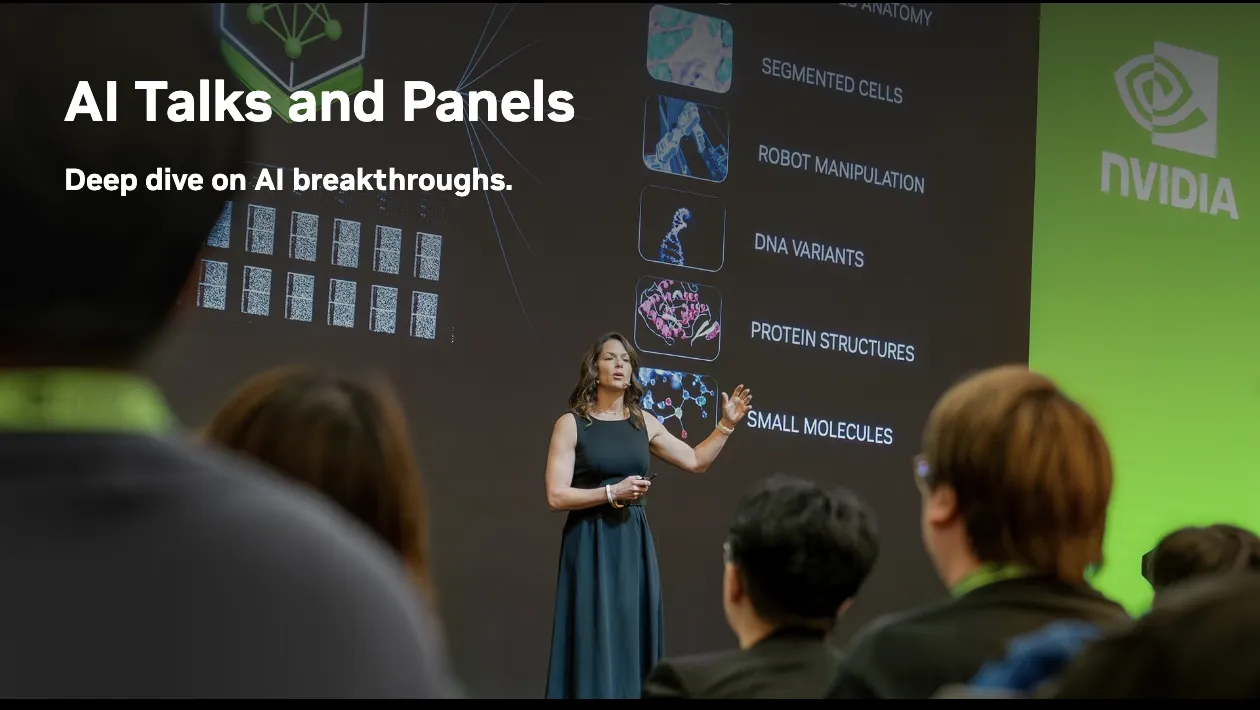
Image Credits: Nvidia, https://www.nvidia.com/en-eu/gtc/
The NVIDIA keynote in Berlin: Jensen Huang at the Tempodrom
The NVIDIA keynote in Berlin is on Wednesday, October 21, 2026, from 11:00 to 13:00 CEST at the Tempodrom. Jensen Huang, NVIDIA's founder and CEO, delivers it live.
Before that, from 9:00 to 11:00, NVIDIA runs its GTC Live pregame show, a mix of conversations with industry leaders and a closer look at how Europe is building and deploying AI. If you have a seat for the keynote, turning up for the pregame is the easiest way to get into the building before the queues get long.
Can everyone get into the keynote?
No, and this is the part people miss. Only the Conference Pass includes a keynote seat, and even those seats are limited. Exhibit Hall Pass holders watch the keynote at an on-site watch party instead, though they can attend the pregame. If you cannot make it to Berlin at all, NVIDIA streams both the keynote and the pregame online, and you can add them to your calendar from the keynote page.
What will Jensen Huang talk about?
NVIDIA does not publish the content of its keynotes in advance. That said, the pattern is fairly predictable. At GTC San Jose in March 2026, Huang covered the full stack, from accelerated computing and AI factories to open models, agentic systems and physical AI, and the Berlin program leans on exactly those themes. Given the setting, it would be a surprise if European topics such as AI infrastructure built in Europe, industrial AI for manufacturers like Mercedes-Benz and Siemens, and robotics partners like Agile Robots and Neura Robotics did not get stage time.
Expect product news, partner announcements and a few guests on stage. Expect it to run long, too, because Jensen keynotes usually do.
Who is speaking at GTC Berlin 2026?
Beyond Jensen Huang, the lineup mixes senior NVIDIA leaders with executives from European industry, AI startups and research. NVIDIA says the list is still growing, so check the official speakers page before you plan your days.
Speaker | Role | Organization |
|---|
Jensen Huang | Founder and CEO (keynote) | NVIDIA |
Jörg Burzer | Board Member and CTO, Development & Procurement | Mercedes-Benz Group |
Christian Senger | CEO, Autonomous Mobility | Volkswagen |
Robin Rombach | Co-Founder and CEO | Black Forest Labs |
Christian Piechnick | CEO and Co-Founder | Wandelbots |
Claire Knight | Director of Engineering | n8n |
Ania Chrzanowska-Kovács | GM, Central and Eastern Europe | ElevenLabs |
Anton Repushko | Head of Research | Revolut |
Andrew McNamara | VP Applied ML Engineering | Shopify |
Pallavi Mahajan | Chief Technology and AI Officer | Nokia |
Alexandre Jacob | Head of R&I Digital Products & Open Digital | L'Oréal |
Tim Anderson | Global Director, Quantitative and Economic Data | London Stock Exchange Group |
Thomas Quernheim | Global SVP, Engineering and Type Approval | TÜV Rheinland |
Anne Bouverot | Chair of the Board, École Normale Supérieure | French Council for AI and Digital |
Jörg Bienert | Managing Director | Center for Sovereign AI (CESAI) |
Bastian Koller | Managing Director | High Performance Computing Center Stuttgart |
Kari Briski | VP, AI Software Product Management | NVIDIA |
Bryan Catanzaro | VP, Applied Deep Learning Research | NVIDIA |
Rev Lebaredian | VP, Physical AI Simulation | NVIDIA |
Kimberly Powell | VP and GM, Healthcare | NVIDIA |
Julien Demouth | Senior Distinguished Engineer, AI Labs and Models | NVIDIA |
The German angle is hard to miss. Mercedes-Benz, Volkswagen, TÜV Rheinland and HLRS all send senior people, and German startups like Black Forest Labs, Wandelbots and n8n are on the program as well.
The expo floor is backed by a long sponsor list. Diamond sponsors are Agile Robots, Dassault Systèmes, Nebius, Nscale, SAP and Siemens. The Platinum tier includes Accenture, AWS, Cisco, CoreWeave, Dell Technologies, Deloitte, EY, Google Cloud, HPE, Lenovo, Microsoft, Mistral AI, Neura Robotics, Oracle, Polarise, Schneider Electric, Supermicro, T-Systems, Together AI, Vertiv and Wandelbots. The full list lives on the sponsors page.
What is discussed at GTC Berlin: topics, sessions and training
The conference program is built around eight themes, spread over more than 100 sessions on October 21 and 22:
Agentic AI and Claws: building AI agents that reason, plan and act, using open models, frameworks and the fast-growing OpenClaw ecosystem.
AI for Science: how agents, simulation and data are pushing research in climate, materials and biology.
AI Infrastructure: turning data centers into what NVIDIA calls AI factories.
CUDA and Libraries: developer tools, SDKs and open-source frameworks for GPU-accelerated apps.
Data Processing: speeding up structured and unstructured data work with cuDF and cuVS.
Industrial AI: digital twins, simulation and CUDA-X for designing products, factories and infrastructure.
Open Models and Datasets: customizing and deploying open models for your own domain.
Physical AI and Robotics: robots, autonomous vehicles and the simulation tools behind them.
A few sessions already stand out in the session catalog. Kari Briski talks about running agentic AI in production with agents you own. Bryan Catanzaro covers open models developers can inspect, adapt and deploy. Rev Lebaredian speaks about Europe's autonomous future with open models and physical AI, and there is a panel on Europe's high-performance AI factories with CINECA. Claire Knight from n8n, who builds workflow automation in Berlin, talks about sovereign guardrails for autonomous agents.
Full-day workshops on October 20
The day before the main conference belongs to hands-on workshops run by the NVIDIA Deep Learning Institute, from 8:30 to 17:00 CEST. These are paid separately from the conference passes. Topics include:
Faster networking for AI infrastructure
Deploying and optimizing AI inference at scale
An end-to-end robotics workflow with NVIDIA Isaac Sim and Isaac GR00T (waitlist)
Agent-first SimReady pipelines for smart factory digital twins with Omniverse and OpenUSD (waitlist)
Building secure AI agents with LLMs (waitlist)
Foundations for AI models and applications, including prep for the AI Factory Associate certification
Buy three or more workshop seats and you save 30 percent.
Two-hour training labs and free certification
On October 21 and 22, eight two-hour training labs are free for Conference Pass holders. They range from financial foundation models on transaction data and drug discovery with BioNeMo to visual AI agents with NVIDIA Cosmos and a lab with n8n on keeping AI agents away from root access.
The real bargain, though, is certification. On-site attendees can take proctored NVIDIA certification exams for free, exams that normally cost between €115 and €425, and both the Conference Pass and the Exhibit Hall Pass include access.
Beyond the sessions
There is also an expo hall, Connect with the Experts sessions where you can ask NVIDIA engineers questions directly, a Startups and VCs track tied to the NVIDIA Inception program, and an expo reception on the evening of October 21.
Tickets and prices for NVIDIA GTC Berlin
Passes start at €357. The full Conference Pass costs €1,785, and all prices include VAT and are charged in euros.
Pass | Regular price | Academic price | What you get |
|---|
Conference Pass (Oct 21-22) | €1,785 | €1,053 | Keynote seat (limited), GTC Live pregame, all sessions, talks and panels, training labs, certifications, Connect with the Experts, expo, receptions, lunch |
Exhibit Hall Pass (Oct 21-22) | €357 | €215 | GTC Live pregame, keynote watch party, Expo Theater talks, Connect with the Experts, certifications, expo, receptions, lunch |
Full-Day Workshop (Oct 20 only) | €471 | €471 | One eight-hour hands-on workshop plus lunch |
Regular pricing runs until October 19. People registering with a university, government or nonprofit email address get 25 percent off conference passes, but you have to show proof at check-in to get your badge, and the discount cannot be stacked with other offers. NVIDIA also has a bundle calculator on the pricing page for teams buying several passes.
One thing to know before you buy: the refund window closed on September 22, 2026, so tickets bought now are non-refundable. You can still hand your pass to a colleague until October 10 by emailing GTC_registration@nvidia.com. If you need to justify the spend internally, NVIDIA has a ready-made convince your manager page.
Registration itself runs through the official GTC Berlin registration portal.
Practical tips for GTC Berlin
A few things that will make the three days easier.
Pick up your badge at the Tempodrom. Registration there opens at 8:00 on keynote day, which also puts you in line early for a seat.
Arrive early for the keynote. Seats are limited even for Conference Pass holders, and NVIDIA itself recommends showing up well before the start. The 9:00 pregame is your excuse to get in first.
Build your agenda before you travel. The session catalog lets you add sessions to your calendar, and live session capacity is limited.
Everything is in English. All sessions and content at GTC Berlin are presented in English.
Book a certification slot. The free proctored exams are one of the best-value parts of the event, and exam sessions are being announced on the training page.
You must be 18 or older to attend in person.
Pay by card. NVIDIA accepts credit and debit cards, and the charge shows up on your statement as "RAINFOC*NVIDIA GTCEU26".
Plan for walking between venues. Tempodrom and STATION Berlin are close, but on October 21 everyone moves at once after the keynote, so leave a buffer before your first session.
Bring business cards or a QR code. The expo reception on the evening of October 21 is the best networking window of the whole event, and it is included in both passes.
If you are a founder, have a look at the NVIDIA Inception program before you go. It is free, and being part of it gives you a reason to talk to the NVIDIA startup team on the expo floor.